1. The Evolution of 3D Packaging Engineering in High-Stakes Sourcing
Modern global procurement for consumer packaged goods (CPG), automotive components, medical devices, and industrial electronics has shifted dramatically from legacy 2D box drafting to sophisticated 3D packaging engineering. In an era dominated by automated high-speed fulfillment centers, cross-border freight vibration, and strict sustainability mandates, off-the-shelf packaging solutions repeatedly fail under real-world dynamic stresses.
3D packaging engineering is the multidisciplinary practice of applying spatial parametric modeling, structural mechanics, fluid dynamic simulation, and polymer thermodynamics to design custom packaging geometry. By working directly within 3D CAD environments (such as SolidWorks, CATIA, and NX), packaging engineers construct custom-fit volumetric enclosures—including heavy-duty thermoformed trays, tamper-evident clamshells, and high-impact protective inserts—that perfectly align with a product’s exact digital twin.
When global OEMs partner with Complete Packaging Group, they eliminate the costly trial-and-error cycle of physical prototyping. Our 3D engineering workflow validates draw ratios, material displacement, draft angles, and structural ribbing prior to cutting a single block of aluminum tooling. This analytical rigor ensures that every pocket, hinge, and stacking feature delivers maximum protective capability while consuming the absolute minimum polymer mass.
Information Gain Insight: Parametric Wall-Thickness Distribution
In standard thermoforming, plastic sheet material stretches unevenly over deep mold cavities, resulting in localized thinning at corners (often called corner wash-out). Advanced 3D packaging engineering utilizes plug-assist simulation software to predict sheet stretching dynamic forces. By optimizing pre-stretch plug geometries and temperature zones, we maintain consistent wall thickness across complex geometry—increasing structural column strength by up to 35% without increasing raw material gauge.
Comparative Analysis: Legacy 2D Packaging vs. Advanced 3D Parametric Engineering
To understand why leading enterprise procurement teams are standardizing on 3D CAD engineering, consider the mechanical and operational performance differences across key manufacturing metrics:
| Engineering Parameter | Legacy 2D Drafting & Manual Mockups | Precision 3D Parametric Engineering |
|---|---|---|
| Dimensional Tolerancing | Loose (±0.030" / 0.76mm); high risk of fit slop | Tight (±0.005" / 0.127mm); exact CAD surface mating |
| Structural Stress Analysis | Empirical physical drop testing (Post-tooling) | Virtual Finite Element Analysis (FEA) prior to tooling |
| Tooling Fabrication Method | Manual pattern casting or wood patterns | High-speed 5-axis CNC aluminum mold machining |
| Material Weight Optimization | Over-gauged sheets to compensate for unknown weakness | Rib-stiffened minimal gauge (15-25% mass reduction) |
| Automated Nesting Ratio | Sub-optimal density; higher freight volume costs | Engineered stack height & zero-waste nesting clearance |
| Prototyping Lead Time | 3 to 6 Weeks (Multiple manual revisions) | 24 to 72 Hours (Direct 3D SLA/FDM rapid printing) |





2. Core 3D Engineered Packaging Solutions & Product Offerings
Every product ecosystem presents unique mechanical vulnerabilities. A delicate medical diagnostic tray requires cleanroom-compatible rigid geometry with sterile barrier protection, while an automotive transmission housing demands impact-resistant heavy-gauge dunnage. Complete Packaging Group leverages 3D engineering across five primary custom packaging product categories:

Precision 3D Thermoformed Trays & Dunnage
Custom-engineered PETG, RPET, HDPE, and ABS plastic trays designed with high-density nesting features, undercuts for snap-fit component retention, and specialized anti-static (ESD) coatings.

Engineered Clamshells & Blister Packaging
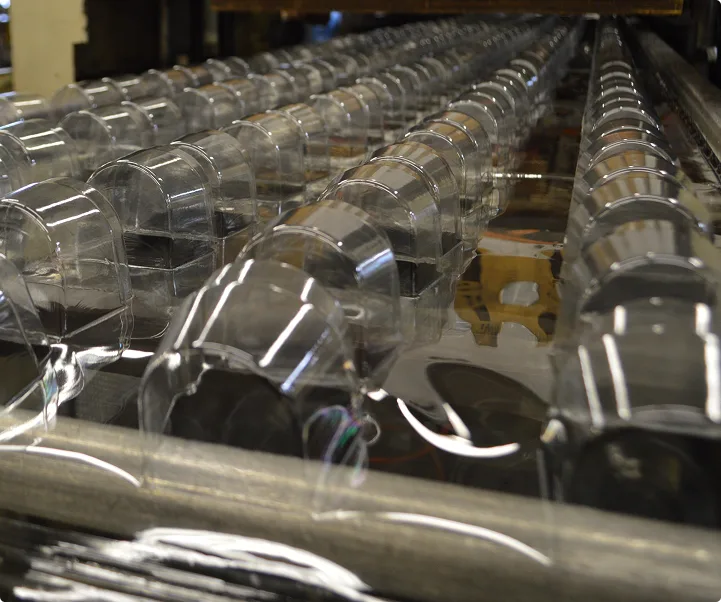
High-clarity security packaging featuring perimeter friction locks, thermoformed living hinges, heat-sealable flange geometry, and integrated hang-tabs for maximum retail point-of-purchase impact.
Detailed Technical Breakdown of Engineered Packaging Categories
A. High-Precision Thermoformed Material Handling Trays
Designed for automated robotic picking and assembly lines, our 3D thermoformed trays feature ultra-tight pocket tolerances (±0.005"). Built from rigid materials such as High Impact Polystyrene (HIPS), Polypropylene (PP), and Recycled Polyethylene Terephthalate (rPET), these trays incorporate structural perimeter ribbing to prevent twisting under heavy payloads.
B. Custom Blister Packaging & Face-Seal Solutions
Combining crystal-clear 3D plastic blisters with heat-seal paperboard cards, these solutions lock products into position while maintaining full retail visibility. Our engineers design perimeter seal flanges with optimized surface area to guarantee 100% bond integrity during high-speed blister card sealing processes.
C. Heavy-Duty Protective Industrial Inserts
Replacing bulky, non-recyclable fabricated foam blocks, engineered 3D thermoformed inserts utilize geometry-driven shock absorption channels. By strategically incorporating crumple zones and localized flexing ribs into rigid PET or HDPE, these inserts absorb G-force impact energy during ISTA 3A drop testing.
D. Modular Point-of-Purchase (POP) Display Trays
Engineered for rapid assembly in retail environments, 3D POP display trays seamlessly integrate with corrugated display shippers. They deliver rigid tiered product staging, structural weight distribution, and precise brand-alignment features required by major big-box retailers.
Have a Complex CAD File Ready for Structural Review?
Our senior packaging engineers will analyze your STEP, IGES, or SolidWorks files to optimize wall thickness, draft angles, and tooling cost efficiency.
Get a Quote3. Future Procurement & Technological Trends in 3D Packaging (2025–2030)
As artificial intelligence, real-time supply chain telemetry, and stringent global environmental legislation reshape manufacturing, procurement executives must align with packaging partners capable of navigating future technology trends.
Trend 1: AI-Assisted Structural FEA & Digital Twin Validation
The integration of artificial intelligence into 3D CAD platforms allows packaging engineers to run multi-physics simulations in minutes. Rather than relying on physical drop testing after tooling is cut, AI algorithms simulate drops from varying heights, vibration harmonics across rail/truck transit, and vertical compressive stacking loads in warehousing environments. This digital-twin validation drastically shortens the R&D cycle for enterprise OEMs.
Trend 2: Closed-Loop Circular Economy Materials & Thin-Gauge Micro-Ribbing
Global packaging directives (such as the EU PPWR and state-level Extended Producer Responsibility laws in the US) mandate higher percentages of Post-Consumer Recycled (PCR) content. However, PCR resins often exhibit higher batch-to-batch melt flow variability. 3D packaging engineering solves this material challenge by applying micro-ribbing patterns and geometric stiffness profiles that allow recycled polymers to achieve structural performance parity with virgin resins.
Trend 3: Smart Packaging Integration (RFID & IoT Enclosures)
As supply chains move toward real-time item-level traceability, thermoformed packaging is increasingly engineered with molded micro-recesses specifically sized to house active RFID tags, BLE beacons, and humidity sensors. 3D spatial engineering ensures these electronic components remain protected from mechanical impact without disrupting high-speed automated denesting processes.
4. Global Procurement & Technical FAQ
To assist global purchasing directors, supply chain managers, and packaging engineers, our technical team has answered the most critical questions surrounding 3D packaging design, tooling, and manufacturing parameters.
We accept all native industry-standard 3D CAD formats, including SolidWorks (.SLDPRT, .SLDASM), STEP (.stp, .step), IGES (.igs), Parasolid (.x_t), and CATIA (.CATPart). If you only have physical product samples, our engineering facility utilizes high-resolution 3D optical scanning to generate accurate CAD surface models within 24 hours.
For standard female vacuum thermoforming mold cavities, we recommend a minimum draft angle of 2° to 3° per side. For male mold designs or deep-draw pockets with textured surfaces, a draft angle of 3° to 5° is preferred to allow easy part ejection without drag marks or sidewall distortion.
FEA simulates structural stress vectors, compression loads, and drop impact forces digitally. By identifying high-stress concentration points before cutting CNC production tooling, we can add targeted geometric reinforcing ribs while thinning down the base sheet gauge across non-critical areas. This material reduction typically yields 10% to 22% ongoing resin savings over the lifespan of a high-volume product run.
At Complete Packaging Group, initial 3D CAD conceptual models are completed within 48 to 72 hours. Rapid 3D-printed or machined wooden prototype samples are typically delivered within 3 to 5 business days. Once prototypes are approved, production-grade 6061-T6 aluminum CNC thermoforming tooling and match-metal trim dies are manufactured in-house within 2 to 4 weeks.
rPET (Recycled Polyethylene Terephthalate) containing 50% to 100% post-consumer content offers an exceptional balance of optical clarity, high tensile strength, and widespread curbside recyclability (RIC #1). Additionally, bio-based PLA (Polylactic Acid) and high-density post-industrial regrind Polypropylene (PP) are excellent sustainable alternatives for specific thermal and chemical applications.
Managing packaging design, thermoforming, contract kitting, and direct drop-shipping under one roof eliminates fragmented multi-vendor supply chain handoffs. Complete Packaging Group assumes 100% single-source accountability—guaranteeing that thermoformed components perfectly fit secondary corrugated cartons, fulfillment assembly runs error-free, and freight schedules are met without intermediary shipping delays.
5. Enterprise Advantages: Why Fortune 500 Brands Choose Complete Packaging Group
For more than 25 years, Complete Packaging Group (headquartered in Brookville, Indiana) has served as an industry-leading turnkey packaging manufacturer for world-class global enterprises, including Procter & Gamble, Honda, L'Oréal, General Mills, and Hasbro.
Unlike traditional brokers or regional thermoformers who outsource their structural engineering and fulfillment, we maintain complete operational control across every phase of the packaging lifecycle:
- 100% In-House 3D Structural Engineering: Our dedicated team of mechanical and packaging engineers utilizes advanced 3D parametric CAD modeling and FEA tools to design optimal packaging architectures.
- State-of-the-Art Tooling & Machining Facilities: We cut precision aluminum thermoforming molds, plug assists, and hardened steel trim dies in our internal CNC machine shop for absolute quality control.
- Scalable High-Speed Production: Operating extensive lines of automated thin-gauge and heavy-gauge thermoforming machinery capable of handling high-volume production runs with strict CPK statistical quality controls.
- End-to-End Turnkey Kitting & Fulfillment: Beyond packaging manufacturing, our 150,000+ sq. ft. facility provides full contract packaging, product kitting, blister sealing, retail display assembly, and direct-to-distribution drop-shipping.
- Rigorous E-E-A-T Quality Management: Adhering to strict ISO quality frameworks, cleanroom packaging environments, and full traceability protocols required by healthcare, aerospace, and consumer enterprise brands.
Ready to Engineer Your Custom 3D Packaging Solution?
Connect directly with our senior structural engineering team. Submit your CAD files or project specifications today for a comprehensive engineering review, material optimization breakdown, and competitive manufacturing quote.