Executive Information Gain & B2B Procurement Summary
In the modern fast-moving consumer goods (FMCG) ecosystem, Consumer Packaged Goods Packaging is no longer just a defensive containment vessel—it is a critical driver of total cost of ownership (TCO) optimization, velocity at retail point-of-sale (POS), damage-rate mitigation, and circular economy compliance. Global buyers searching for enterprise packaging partners face complex trade-offs between unit cost, structural integrity, material sustainability (EPR laws), and automated assembly compatibility.
This strategic blueprint, engineered by senior packaging structural engineers at Complete Packaging Group, addresses real-world operational bottlenecks. It outlines material selection matrices, custom thermoforming capabilities, contract kitting workflows, and forward-looking market trends designed to give high-volume CPG brands a decisive market advantage.
1. The Strategic Architecture of Consumer Packaged Goods (CPG) Packaging
The market dynamics governing Consumer Packaged Goods (CPG) have undergone a radical transformation. Consumer packaged goods encompass everyday items—ranging from personal care products, cosmetics, and food & beverage to over-the-counter pharmaceuticals, household goods, and consumer electronics. In this ultra-competitive environment, packaging must simultaneously execute three foundational directives:
- Structural Protection & Damage Mitigation: Ensuring zero product degradation across complex multi-modal supply chains (ocean freight, intermodal rail, parcel drop-shipping, and retail distribution centers).
- Commercial & Visual Delineation: Maximizing visual contrast and brand equity on crowded retail shelves (Big-Box retail, Club stores, and specialty boutiques).
- Supply Chain Friction Reduction: Minimizing dimensional weight (DIM weight), optimizing pallet density, and facilitating high-speed automated packaging line integration.
At Complete Packaging Group, based in Brookville, Indiana, our 25-plus years of manufacturing operations have proven that fragmented supply chains—where design, tooling, plastic thermoforming, and contract assembly are handled by disparate vendors—introduce unacceptable failure rates, cost overruns, and scheduling delays. Achieving superior performance in CPG packaging requires an end-to-end turnkey methodology.
Proven Partner to Global FMCG Leaders





2. Structural Material Selection Matrix for High-Volume CPG Products
Selecting the correct polymer substrate or material substrate is a pivotal decision in CPG structural engineering. Procurement teams must balance optical clarity, impact resistance, barrier functionality, cost-per-pound, and end-of-life recyclability. Below is our engineering benchmark comparison for primary thermoformed and rigid CPG packaging materials:
| Material Substrate | Optical Clarity & Aesthetics | Impact Strength & Durability | Recyclability & Circularity | Ideal CPG Application Segments |
|---|---|---|---|---|
| rPET (Recycled Polyethylene Terephthalate) | Exceptional (90%+ transparency) | High toughness & crack resistance | 100% Recyclable (RIC #1 curbside) | Cosmetics, personal care, retail blister packs, club-store clamshells |
| PETG (Polyethylene Terephthalate Glycol) | Ultra-High clarity & gloss | Superior impact resistance & deep-draw formability | Specialized recycling streams | Medical CPG, premium beauty, heavy hardware packaging |
| PP (Polypropylene) | Translucent to Opaque | Excellent living-hinge capability & flex life | Recyclable (RIC #5 expanding) | Microwavable food containers, personal care caps/trays, reusable packaging |
| HDPE (High-Density Polyethylene) | Opaque / Matte finish | High drop-impact & chemical resistance | High infrastructure recyclability (RIC #2) | Household chemical trays, automotive components, bulk industrial CPG |
| Bio-based Polymers (PLA/PHA & Molded Fiber) | Natural / Matte / Variable | Moderate structural strength; sensitive to humidity | Industrial Composting / Biodegradable | Eco-conscious food service, organic personal care, premium sustainable lines |
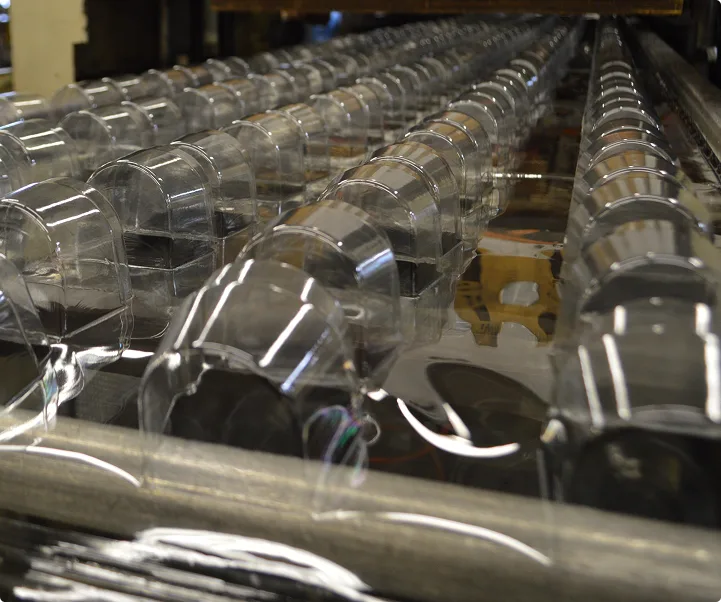
3. Core CPG Packaging Form Factors & Product Solutions
Depending on retail positioning, loss prevention requirements, and unboxing expectations, CPG brand managers must deploy specific structural formats. Complete Packaging Group specializes in five primary product categories engineered to drive consumer conversion while minimizing transit damage.
Custom Blister Packaging
Blister packaging combines a thermoformed plastic cavity with a printed backing card (heat-sealed paperboard or foil laminate). It provides maximum product visibility while preserving security.
- Face-Seal Blisters: Cost-effective heat-sealing for lightweight retail merchandise.
- Trapped Blisters: Plastic thermoform captured between two die-cut cards, eliminating heat-seal tooling expenses and enhancing eco-perceptions.
- Slide Blisters: Folded-edge designs for manual assembly and re-closability.
Security Clamshell Packaging
Clamshells are hinged, two-piece plastic enclosures that snap shut or are ultrasonic-welded for maximum anti-theft security in high-shrink retail categories.
- Heavy-Duty Retail Clamshells: Engineered with rPET to withstand aggressive handling and prevent retail pilferage.
- Standing & Tri-Fold Clamshells: Built-in base features allowing products to stand upright on retail shelves or hang from peg hooks.
- Tamper-Evident Seals: Integrated perimeter button-locks and perimeter sealing lines.
Thermoformed Industrial & Material Handling Trays
Custom plastic trays engineered for internal component organization, automated pick-and-place robotics, and protective shipping inserts.
- Automation-Grade Trays: Precision tolerances (±0.005”) engineered for high-speed robotic loading lines.
- ESD/Anti-Static Trays: Conductive and dissipative materials for sensitive electronic consumer goods.
- Kitting Trays: Multi-cavity layout designed to hold multi-component product sets perfectly in place.
Point-of-Purchase (POP) & Retail Displays
Turnkey retail merchandisers, side-wing displays, and counter-top units that convert shoppers at the critical moment of purchase.
- Club Store Merchandising Displays: Built to meet strict Costco, Sam's Club, and BJ's structural pallethandling guidelines.
- Dump Bins & Power Wings: High-impact corrugated and plastic hybrid retail display structures.
- Full Contract Assembly: Shipped pre-loaded with product for rapid retail floor deployment.
4. Future Global Procurement Trends in CPG Packaging (2025–2030+)
Enterprise purchasing departments must align their packaging strategies with macroeconomic changes, evolving legislation, and technology integration. Key mega-trends reshaping global Consumer Packaged Goods packaging include:
A. Extended Producer Responsibility (EPR) & Post-Consumer Recycled (PCR) Mandates
Governments across North America and Europe are instituting stringent Extended Producer Responsibility (EPR) regulations, penalizing non-recyclable multi-material packaging and mandating minimum PCR content thresholds (often 25% to 50% by 2030). CPG procurement officers are rapidly converting legacy PVC and multi-layer non-recyclable structures into high-clarity rPET and monomaterial polyolefins.
B. Omnichannel Packaging & "SIOC" (Ships-in-Own-Container) Engineering
With the rapid rise of D2C (Direct-to-Consumer) e-commerce alongside traditional brick-and-mortar channels, CPG brands face high returns due to shipping damage. Modern packaging must pass rigorous ISTA 6-Amazon certification standards. Designing packaging that serves dual purposes—vibrant on retail shelves while resilient against 17-point parcel drops—drastically reduces logistics costs.
C. Smart & Connected Packaging Integration
CPG packaging is transitioning into a digital touchpoint. Incorporating high-density QR codes, RFID tags, and NFC chips into primary thermoforms and secondary folding cartons enables:
- Real-time track-and-trace supply chain visibility to prevent diversion and grey-market sales.
- Enhanced consumer engagement, allowing buyers to verify product authenticity, scan for ingredients, or view interactive usage guides via smartphones.
- Automated inventory management in modern automated fulfillment centers.


5. Enterprise Leadership: Why Global Brands Partner with Complete Packaging Group
Establishing Experience, Expertise, Authoritativeness, and Trustworthiness (E-E-A-T) is essential when selecting an OEM/ODM packaging manufacturer. Complete Packaging Group brings proven capabilities to the global stage:
25+ Years Industrial Mastery
Founded in 1999 in Brookville, Indiana, our facility has delivered over 500+ successful enterprise packaging programs with zero defect compromises.
Single-Source Turnkey Efficiency
We eliminate vendor fragmentation by hosting structural CAD engineering, aluminum tooling, high-speed thermoforming, kitting, and drop-shipping under one roof.
Tier-1 Brand Endorsements
Trusted contract partner for global Fortune 500 giants including Procter & Gamble, L'Oréal, Honda, General Mills, and Hasbro.
Complete Turnkey Execution Process
Our proprietary 4-stage turnkey framework guarantees project delivery on schedule and strictly within budget parameters:
- Structural CAD & Rapid 3D Prototyping: Conceptualizing optimized geometries using 3D modeling and physical sample testing within days, not weeks.
- Tooling & Precision Mold Manufacturing: In-house CNC machining of production-grade aluminum tooling to ensure exact tolerances and long-run durability.
- High-Speed Automated Thermoforming: Operating state-of-the-art continuous roll-fed pressure-forming machinery with integrated inline vision inspection.
- Contract Kitting, Fulfillment & Drop-Shipping: Manual or automated loading of consumer products, sealing, master carton packing, and direct delivery to retail distribution hubs nationwide.
6. Frequently Asked Questions (FAQ) for CPG Packaging Buyers
Below are authoritative answers to the most frequent technical and procurement questions posed by global purchasing directors and packaging engineers:
Multi-vendor sourcing introduces hidden supply chain costs, including freight between suppliers, accumulated margin stack, misaligned dimensional tolerances, and multi-party liability when quality issues arise. A turnkey single-source manufacturer like Complete Packaging Group consolidates structural engineering, tooling, plastic thermoforming, secondary printing, and assembly. This reduces overall lead times by up to 40%, eliminates intermediate freight charges, and guarantees 100% accountability under one roof.
Our streamlined engineering protocol allows for initial 3D CAD modeling and prototype samples within 3 to 5 business days. Once prototype samples receive formal sign-off, production-grade aluminum tooling is CNC-machined in-house within 2 to 3 weeks. Full-scale production and initial contract fulfillment cycles typically range from 2 to 4 weeks, depending on order complexity and material raw stock availability.
Retail shrink accounts for tens of billions in annual losses for big-box retailers. Custom security clamshells and trapped blister packs are structurally designed to maximize perimeter footprint, making them difficult to conceal. Furthermore, heavy-gauge rPET or PETG construction combined with perimeter heat-sealing or ultrasonic sealing requires tools to open, effectively deterring in-store tampering while preserving high visual transparency.
Yes. Sustainability is built directly into our material procurement architecture. We manufacture custom thermoforms using up to 100% Post-Consumer Recycled (PCR) rPET resin, fully compliant with curbside recycling streams (RIC #1). Additionally, we engineer plastic-free trapped blister cards utilizing FSC-certified paperboard and water-based heat-seal coatings to satisfy stringent brand sustainability benchmarks.
Our manufacturing operations adhere strictly to rigorous ISO quality control frameworks. We utilize automated inline vision systems, dimensional gauge checks, denesting verification, and drop/seal strength testing. Every lot undergoes strict statistical process control (SPC) prior to staging for assembly, contract kitting, or drop-shipping.
Initiating a project consultation is seamless. Simply supply our engineering team with your product physical dimensions, target launch dates, estimated annual unit volumes (EAV), and retail distribution requirements. Click our direct inquiry portal below to consult instantly with an experienced packaging engineer.