The Technical Imperative of Custom Blister Packaging

In modern B2B retail, consumer electronics, medical device, and automotive parts manufacturing, packaging is far more than a physical container—it is a critical mechanical interface that balances product security, visual merchandising, and supply chain speed. Global procurement leaders searching for custom blister packaging face complex engineering choices: balancing heat-seal coating chemistry against cardboard calipers, selecting plastic resins that meet strict sustainability criteria without sacrificing clarity, and managing tooling amortization across volatile volume demands.

At Complete Packaging Group, operating from our state-of-the-art facility in Brookville, Indiana, we bridge the gap between initial structural packaging CAD design and high-speed automated fulfillment. By integrating 3D thermoforming tooling, high-clarity plastic extrusion, precision die-cutting, and contract assembly under a single roof, we eliminate intermediate supply chain markups and guarantee seamless performance on retail shelves across the globe.
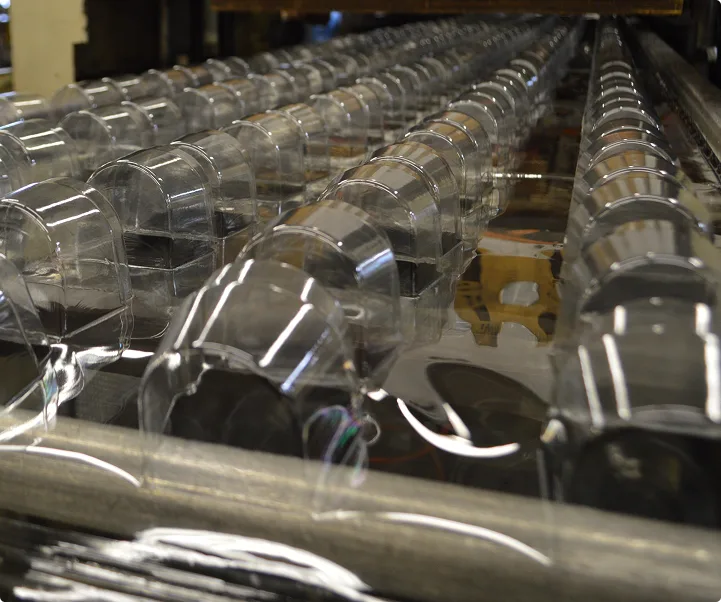

Complete Packaging Group Custom Blister Packaging Manufacturing Plant

Custom Blister Packaging Product Matrix

Every consumer product possesses unique structural geometry, weight distribution, and security requirements. Below is our engineered line-up of custom blister packaging styles tailored for global procurement managers seeking optimized unit economics and maximum shelf presentation.

Retail & Hardware

Face-Seal Blister Packs

The industry standard for high-volume consumer goods, hardware, and cosmetics. A thermoformed plastic pocket is heat-sealed directly onto the surface of a printed paperboard card coated with specialized heat-seal lacquer.

  • Plastic Resins: RPET, APET, PVC
  • Card Stock: 18pt - 24pt SBS Cardboard
  • Flange Width: 0.25" - 0.375" (6.35 - 9.5mm)
  • Key Advantage: Lowest Unit Production Cost
Get Catalog
Sustainable & Anti-Theft

Trapped Blister Packaging

A high-security, eco-conscious alternative. The thermoformed plastic blister is captured ("trapped") between two die-cut fold-over cards or separate front-and-back cards, hiding the plastic flange completely.

  • Plastic Usage: Reduced by up to 40%
  • Recyclability: Easy Plastic/Paper Separation
  • Theft Protection: High Tear Resistance
  • Key Advantage: Premium Branding Canvas
Get Catalog
Consumer Tech & Multi-Piece

Full-Face Seal & Slide Blisters

Features a thermoformed plastic flange that extends across the entire dimensions of the backing card, offering superior edge protection against shipping abrasion or sliding plastic channels for reusable packaging.

  • Impact Resistance: Maximum Corner Defense
  • Reusability: Optional Slide-Track Fit
  • Display Style: Hanging Peg / Standing Base
  • Key Advantage: Superior Retail Durability
Get Catalog
High-Security Retail

Full Clamshell & Tri-Fold Packaging

Heavy-duty thermoformed containers hinged on one or two sides that snap securely shut or can be permanently radio-frequency (RF) or friction welded. Designed specifically for high-value retail products vulnerable to shoplifting.

  • Thickness Gauge: 15 mil - 40 mil High-Caliper
  • Sealing Methods: RF Weld, Ultrasonic, Snap Buttons
  • Merchandising: 360-Degree Product Visibility
  • Key Advantage: Ultimate Tamper & Theft Resistance
Healthcare & Precision Electronics

Medical & High-Barrier Trays

Sterile-grade thermoformed blister packaging manufactured under rigorous cleanliness protocols. Engineered with high-barrier polymers or lidstock foils to protect against moisture vapor transmission (MVTR) and oxygen oxidation (OTR).

  • Resin Types: PETG, Cyclic Olefin, Tyvek Lidding
  • Compliance: ISO 11607 Packaging Standards
  • Sealing Tech: Cleanroom Medical Heat Sealing
  • Key Advantage: Critical Barrier & Sterility Maintenance

Custom Blister Polymer & Cardboard Technical Comparison

Selecting the optimal resin grade and cardboard substrate directly determines structural failure thresholds, clarity under retail lighting, heat seal dwell speed, and lifecycle carbon metrics. Below is an engineering comparison matrix developed by our in-house thermoforming engineers.

Material Resin / Substrate Optical Clarity (%) Tensile / Impact Strength Heat Seal Temp Window MVTR / OTR Barrier Curbside Recyclability Target B2B Application
RPET (Recycled PET - Min 50% PCR) 90% - 93% High (Flex-resistant) 310°F - 345°F (154°C - 174°C) Moderate / Moderate 100% (RIC #1) General Retail, Consumer Electronics, Cosmetics
APET (Amorphous PET) 92% - 95% Very High 320°F - 350°F (160°C - 176°C) Moderate / Moderate 100% (RIC #1) Premium Cosmetics, Heavy Tools, Hardware Kits
PETG (Glycol-Modified PET) 94% - 96% Superior (Non-brittle) 290°F - 330°F (143°C - 165°C) High / Moderate Specialty Recyclable Medical Devices, Surgical Trays, Cold-Storage Packs
PVC (Polyvinyl Chloride) 88% - 91% Moderate 280°F - 320°F (137°C - 160°C) Moderate / Low Low (RIC #3) Legacy Hardware, Low-Cost Industrial Components
High-Barrier Foil / Tyvek Opaque (0%) Puncture Resistant 340°F - 380°F (171°C - 193°C) Near Zero (Absolute) Industrial Thermal Recycled Pharmaceuticals, Diagnostics, Aerospace Sensors
18-24pt SBS Cardstock (Solvent Coated) N/A (Print Layer) High Stiffness / Tear Seals to RPET/APET/PVC Hydrophobic Coating Option 100% Paper Stream Face-Seal & Trapped Blister Backing Cards

Future Trends in Custom Blister Packaging & Automated Procurement

The global packaging sector is undergoing a massive shift driven by stringent EPR (Extended Producer Responsibility) legislation, retail compliance mandates (including Amazon ISTA-6 and Walmart Packaging Scorecards), and AI-driven supply chain automation. Procurement managers must position their brands ahead of these mega-trends:

1. Bio-Polymers & Monomaterial Circularity

The industry is rapidly phasing out non-recyclable multi-layer films in favor of monomaterial RPET and bio-based PLA (Polylactic Acid) formulations. Thermoforming lines are being re-engineered to handle ultra-high post-consumer content (up to 80% PCR) without experiencing micro-cracking or optical yellowing.

2. Automation-Ready High-Speed Sealing

Manual labor costs in kitting and assembly have driven the demand for blister designs built specifically for cobot (collaborative robot) pick-and-place indexing. Custom blisters are now designed with mechanical draft angles and de-nesting lugs optimized for high-speed automated loading trays.

3. Smart Blisters & Digital Watermarking

Integrating GS1 Digital Link QR codes and Digimarc invisible watermarking directly onto thermoformed blister pockets allows high-speed scanning at automated checkout while providing consumers with real-time supply chain transparency and digital authentication.

Get Catalog & Sustainability Specification Sheet

Why Fortune 500 Brands Trust Our Custom Blister Manufacturing

For over 25 years, Complete Packaging Group has provided end-to-end turnkey packaging solutions that eliminate third-party delays, minimize transport emissions, and lower total procurement cost of ownership (TCO). Our integrated approach combines design, thermoforming, printing, and automated contract fulfillment under one roof.

  • In-House Tooling & Rapid Prototyping: State-of-the-art CNC machining allows us to transition from approved 3D CAD models to production-grade aluminum molds in days, not months.
  • Full Contract Kitting & Assembly: We don't just supply the plastic—we load your products, heat-seal the cards, pack master cartons, and ship directly to distribution hubs.
  • Strategic US Midwest Location: Situated in Brookville, Indiana, our centralized hub ensures rapid 1-to-2 day ground freight reach to over 70% of North America's retail markets.

Validated by Global Industry Leaders

Our relentless commitment to quality control, structural integrity, and zero-defect delivery schedules has made us a trusted strategic manufacturing partner to world-class enterprise brands:

Procter & Gamble Logo
L'Oreal Logo
Honda Logo
Hasbro Logo

Custom Blister Packaging B2B Procurement FAQ

In-depth technical answers addressing complex engineering, tooling cost structures, heat-sealing window diagnostics, and structural integrity queries routinely analyzed by procurement teams and AI search engines.

What are the precise parameters for heat-sealing thermoformed blisters to coated cards?

Successful heat-sealing depends on three variables: temperature, pressure, and dwell time. For standard PET/RPET blisters sealed to 18-24pt SBS cardstock with a solvent-based vinyl heat-seal lacquer, operating parameters are typically 310°F to 360°F (154°C to 182°C) heater plate temp, 60 to 80 PSI pneumatic line pressure, and a dwell time of 1.5 to 3.0 seconds. Insufficient heat leads to fiber-tear failure, while excess heat scorches the print varnish or warps the thermoformed plastic flange.

How does trapped blister packaging reduce total plastic content while improving security?

Trapped blister packaging captures the flange of a thin-gauge thermoformed blister between two die-cut cardstock layers glued together with cold or hot-melt adhesive. Because the structural stiffness is provided primarily by the paperboard sandwich rather than heavy-gauge plastic, plastic sheet thickness can be reduced by 30% to 40% (e.g., from 20 mil down to 12 mil RPET). Security is upgraded because the trapped flange cannot be easily pried off the card without destroying the entire paperboard assembly, deterring in-store theft.

What draft angles and undercut allowances are required for custom blister tooling?

Optimal thermoforming tool design requires a minimum draft angle of 2° to 5° degrees on all male core cavities to ensure clean mechanical ejection without drag marks or stress whitening. For female vacuum molds, a 1° to 3° draft is standard. Undercuts designed for mechanical snap-fit closures require segmented pneumatic slide blocks within the aluminum mold, which increases initial tooling complexity but allows reusable snap-lock clamshell features.

What is the difference between APET, RPET, and PETG resins in blister thermoforming?

APET (Amorphous PET) is virgin PET offering crystal clarity and high tensile strength. RPET contains Post-Consumer Recycled content (typically 30% to 100%), matching APET's clarity while meeting recycled material mandates. PETG is modified with glycol, preventing crystallization during thick-gauge forming; it is easier to heat-seal or gamma sterilize, making it ideal for medical packaging, though it cannot be mixed into standard PET recycling streams (RIC #1).

How does Complete Packaging Group manage custom tooling lead times and amortization?

We operate an in-house CNC tool and die shop. Initial 3D CAD structural concepts and prototype samples (produced via SLA 3D printing or single-cavity aluminum test blocks) are delivered within 5 to 7 business days. Production multi-cavity aluminum molds are completed within 2 to 3 weeks. For multi-million unit contracts, tooling costs can be partially or fully amortized into the piece price of the initial production run.

What testing standards are utilized to validate transit security for custom blisters?

Our blister packages undergo rigorous transit simulation testing, including ISTA-3A and ISTA-6-Amazon.com protocols. Testing evaluates drop resistance from specified heights, random vibration testing across frequencies (1-200 Hz), compression loading for warehouse stacking, and environmental chamber testing (-20°F to 140°F / 5% to 85% RH) to ensure heat-seal bonds do not delaminate during transit.

Request Your Custom Blister Tooling & Production Estimate

Whether launching a new retail consumer line or re-engineering an existing blister pack for cost reduction and eco-compliance, our engineering team is standing by to deliver 3D CAD prototypes and comprehensive price quotes.

Get Catalog Contact Engineering Team
Direct Technical Support: (765) 547-1300