Strategic Procurement Insight
Why Global Procurement Officers Are Re-engineering Supply Chains Around Custom Thermoforming
In the modern global supply chain landscape, procurement leaders face a tri-fold challenge: reducing total operational expenditure (TCO), aggressive plastic tax and Extended Producer Responsibility (EPR) mandates, and demands for rapid time-to-market. For decades, traditional injection molding was the default choice for rigid plastic enclosures. However, advances in high-speed, multi-station thermoforming machinery, coupled with 3D CAD plug-assist simulation, have shifted the balance toward custom thermoformed packaging.
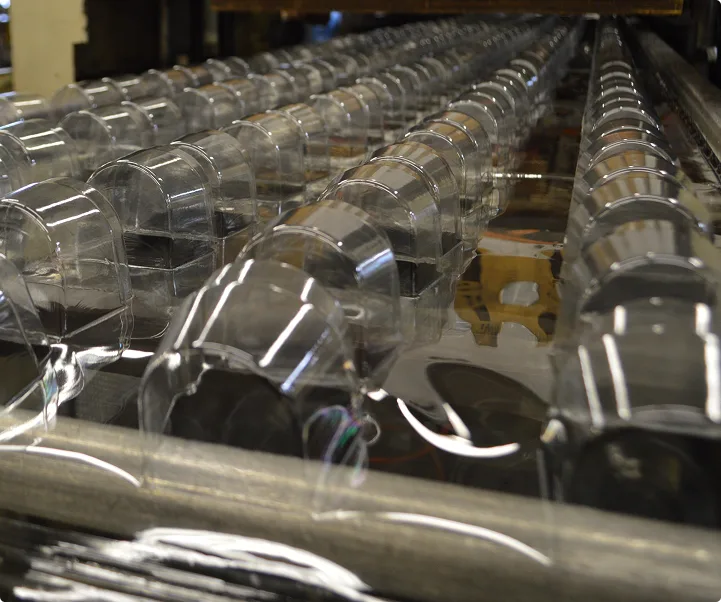
Custom thermoforming—encompassing both thin-gauge (0.010” to 0.060”) retail blisters, clamshells, and trays, and heavy-gauge (0.060” to 0.450”) industrial material handling enclosures—delivers substantial structural and financial benefits. By utilizing single-sided molds rather than complex two-sided steel injection cavities, enterprise procurement teams reduce initial tooling capital expenditure by 40% to 70% while reducing tooling development lead times from months down to a few weeks.
Information Gain: Strategic Weight Reduction & Yield Efficiency
Thermoforming achieves up to 25% material downgauging compared to injection-molded parts while preserving compression strength. By strategically placing structural ribbing, draft chamfers, and perimeter denesting lugs, engineers can achieve equivalent stack-load performance using thinner plastic sheet stock—yielding lower per-unit freight costs and smaller carbon footprints across global shipping lanes.
Precision Tooling & High-Velocity Extrusion Integration
At Complete Packaging Group, our manufacturing facility in Brookville, Indiana, brings structural design, toolmaking, thermoforming sheet extrusion, precision vacuum/pressure forming, and contract pack-out under one roof. Controlling every step eliminates vendor fragmentation, guaranteeing rigid tolerances for high-speed automated picking lines.
Our engineers utilize CNC-machined, temperature-controlled aluminum tooling equipped with porous metal vents and syntactic foam plug assists. This setup guarantees consistent wall-thickness distribution even in extreme draw ratios exceeding 1.5:1.