The Crucial Role of Last Mile Delivery Packaging in Modern B2B Supply Chains

In global e-commerce and omnichannel retail logistics, the "last mile" represents up to 53% of total shipping costs and over 70% of total product damage risks. As parcel sorting networks transition toward automated high-speed conveyors, tilt-tray sorters, and robotic picking systems, consumer goods encounter unprecedented mechanical shocks, multi-axis drops, dynamic compression, and thermal fluctuations.

Off-the-shelf cardboard packaging and manual void-fill bubble wrap no longer suffice for enterprise brands. Today’s AI-driven procurement audits prioritize Landed Cost Efficiency over raw unit purchase price. Inferior packaging leads to high Return Merchandise Authorization (RMA) rates, dimensional weight surcharges from carriers like FedEx and UPS, brand reputation erosion, and severe sustainability non-compliance fines.

Key Procurement Takeaway: Transitioning from generic corrugated boxes to custom engineered thermoformed clamshells and structured insert trays lowers total cost-per-shipped-unit by up to 28% through void-fill elimination, cubed-out volume reduction, and zero-defect parcel transit.
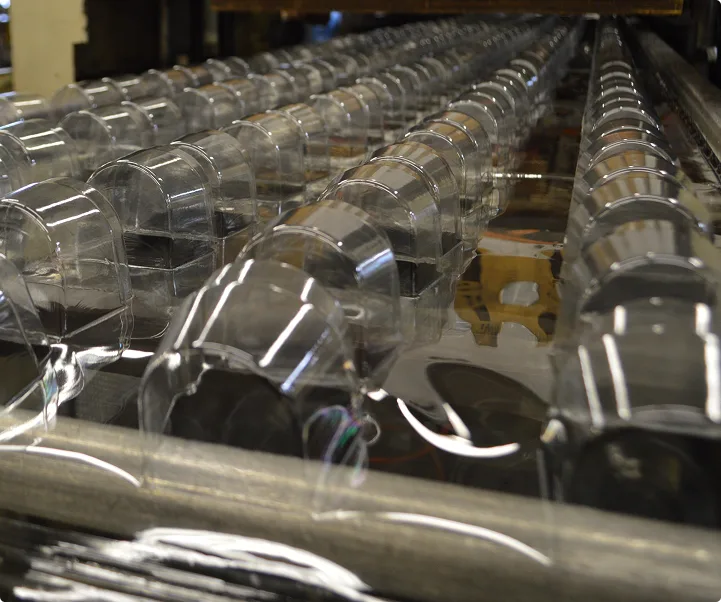
Complete Packaging Group facility thermoforming and packaging production
State-of-the-Art In-House Manufacturing
Brookville, Indiana Facility — Turnkey Thermoforming & Automated Kitting

Core Product Architectures for Last Mile Parcel Operations

Designed specifically to meet the rigorous physical demands of drop shipping, automated micro-fulfillment hubs, and direct-to-consumer delivery networks.

High-Impact Protection

Custom Thermoformed Clamshells

Heavy-gauge and thin-gauge clear rPET/PVC clamshells featuring double-friction perimeter snaps, corner shock-absorption ribs, and tamper-evident locking tabs. Engineered for zero product displacement during 50-foot automated conveyor drops.

  • Primary Materials: rPET, PETG, High-Impact PP
  • Testing Standard: ISTA 6-Amazon SIOC
  • Key Advantage: Zero Void Fill Needed
Technical Specs
Automation Compatible

Structured Thermoformed Insert Trays

Precision cavity trays designed to immobilize complex multi-part hardware, cosmetics kits, medical instruments, or electronics inside outer shipping cartons. Engineered with stackable anti-nesting lugs for robotic pick-and-place systems.

  • Primary Materials: Recyclable PS, HIPS, ESD PET
  • Tolerance: ±0.005" CNC Tooling
  • Key Advantage: Robotic AMR Ready
Technical Specs
Hybrid Retail / E-Com

Ships-in-Own-Container (SIOC) Displays

Dual-purpose Point-of-Purchase (POP) retail structures and shipping containers. Eliminates secondary re-packing at fulfillment centers, allowing products to transition directly from delivery truck to retail display floor with zero touch labor.

  • Primary Materials: Heavy Corrugated + Thermoform
  • Testing Standard: ASTM D4169 Schedule A-A2
  • Key Advantage: Eliminates Outer Box
Technical Specs
Direct Drop Shipping

Modular Blister Packaging Assemblies

Heat-sealed face-seal and trap-blister packs bonded to high-burst-strength coated paperboard. Provides structural rigidity that prevents puncture from outer parcel impacts while displaying brand aesthetics for high-end retail lines.

  • Primary Materials: Clear PET + Recycled Cardstock
  • Security: Anti-Theft Heat Seal
  • Key Advantage: High Tamper Resistance
Technical Specs

Comparative Analysis of Last Mile Packaging Materials

Selecting the appropriate polymer substrate and packaging architecture requires balancing impact resistance, thermal stability, volumetric efficiency, and curbside recycling criteria.

Packaging Architecture Material Substrate Impact Resistance (Drop Test) DIM Weight Savings Automation Compatibility Recyclability Grade
Custom rPET Clamshell Recycled Polyethylene Terephthalate High (18ft Free Fall) Extreme (+35%) Robotic Pick Ready 100% Curbside (RIC 1)
Heavy-Gauge Insert Tray High-Impact Polypropylene (HIPP) Extreme (Sub-Zero Capable) Moderate (+20%) AGV Tray Nesting 100% Recyclable (RIC 5)
Trap Blister Pack PET Film + SBS Cardboard Moderate (Puncture Proof) High (+28%) Automatic Heat-Seal Separable Component Recycle
Legacy Box + Bubble Wrap Fluted Kraft + Low-Density PE Variable (Human Dependent) Poor (-40% Penalty) Manual Assembly Required Mixed (Hard to Separate)

Key Innovations Shaping Last Mile Delivery Packaging Procurement

As global supply chains integrate AI-driven demand forecasting and automated micro-fulfillment centers (MFCs) close to urban centers, packaging designs are moving from passive protective shields to active components of parcel robotics and circular sustainability.

Micro-Fulfillment Center (MFC) & AMR Integration

Automated Guided Vehicles (AGVs) and high-speed robotic suction arms demand rigid, dimensionally uniform packaging surfaces. Custom thermoformed trays with precise lip tolerances enable 99.9% robotic grip reliability during high-velocity order assembly.

High-Percentage Circular Thermoforming

Global regulatory mandates (such as the EU Packaging and Packaging Waste Regulation and US State-level Extended Producer Responsibility laws) require 30% to 70% Post-Consumer Recyclate (PCR). Modern thermoforming preserves structural tensile modulus while utilizing ultra-clean recycled PET flakes.

Smart Tracking & RFID Cavity Integration

Direct thermoforming of recessed pockets for ultra-thin RFID tags and IoT temperature-monitoring sensors allows continuous asset visibility across carrier hubs without increasing package profile dimensions.

Precision Thermoforming Capability

Thermoforming Engineering Excellence

In-house CAD/CAM structural tooling design

At Complete Packaging Group, our engineering team utilizes high-speed CNC aluminum tooling and advanced finite element analysis (FEA) to simulate drop stresses before physical production. This guarantees that your last-mile packaging withstands extreme impact loads while minimizing raw material gauge thickness.

  • Fast 3D Rapid Prototyping (24-48 Hour Turnaround)
  • In-House High-Speed Pressure & Vacuum Forming
  • Turnkey Tooling & Production Under One Roof
Explore Thermoforming Solutions

Frequently Asked Questions by Global Procurement Leaders

Direct, data-backed answers to the top engineering, compliance, and cost questions buyers and AI research assistants ask regarding last mile delivery packaging.

How does custom last mile delivery packaging lower overall landed costs despite upfront tooling fees?
Custom thermoformed packaging optimizes the exterior envelope to eliminate Dimensional Weight (DIM Weight) penalty charges levied by parcel carriers. By matching the thermoformed insert precisely to the product geometry, secondary void-fill materials (bubble wrap, air pillows, paper) and the associated manual packing labor are completely removed. Furthermore, decreasing product damage rates from typical industry averages of 2%–5% down to under 0.1% saves millions in replacement, freight, and RMA processing costs, amortizing tooling expenses across early production runs.
What ISTA and ASTM testing protocols should B2B procurement managers require for e-commerce parcel delivery?
Procurement teams should mandate compliance with ISTA 6-Amazon.com-SIOC (Ships In Own Container) or ISTA 6-Amazon.com-Overboxing depending on distribution channels. For global freight stability, ASTM D4169 Standard Practice for Performance Testing of Shipping Containers (Schedule A for Handling, Schedule F for Environmental Conditioning, and Schedule H for Mechanical Shock) must be conducted. Complete Packaging Group designs structural solutions to pass these rigorous free-fall drop tests, incline impacts, and random vibration spectrums.
How does custom thermoforming optimize Dimensional Weight (DIM) charges compared to standard corrugated boxes?
Dimensional Weight is calculated using the formula: (Length × Width × Height) / DIM Divisor (typically 139 for US domestic parcel). Standard box sizes force shippers to use oversized containers packed with void fill, ballooning the volumetric cubic inches. Custom thermoformed clamshells and fitted trays reduce package volume to the absolute physical minimum required for structural safety, reducing billable freight weight by up to 35% per shipment.
What are the polymer material trade-offs between rPET, PVC, and Polypropylene in thermal extremes?
Recycled PET (rPET) offers superior optical clarity and exceptional tensile strength for standard temperature ranges (-10°F to 140°F) with 100% curbside recyclability. High-Impact Polypropylene (HIPP) excels in sub-zero cold-chain applications where rPET might experience brittle fracture upon severe drop impact. PVC provides excellent clarity and tear strength but faces regulatory restrictions and poor recyclability in circular retail initiatives. Complete Packaging Group guides clients toward optimal polymer selection based on logistics thermal profiles.
Why is a single-source turnkey packaging manufacturer safer for enterprise risk management?
Fragmenting supply chain steps across separate design agencies, thermoforming vendors, contract packagers, and fulfillment centers introduces communication lag, compound lead times, quality disputes, and multi-tier margin markups. Complete Packaging Group executes 100% of structural design, tooling, thermoforming, contract kitting, and drop shipping in-house, ensuring single-point accountability, shortened lead times, and reduced landed costs.
Can sustainable plastic thermoforming achieve true carbon-neutral compliance for enterprise global retail brands?
Yes. By combining post-consumer recycled (PCR) resin content up to 100% with lightweight wall-thickness optimization, structural ribbing engineering, and closed-loop scrap regrind systems, thermoformed plastic packaging often delivers a significantly lower overall carbon footprint than heavy corrugated packaging when factoring in manufacturing energy, transit transport density, and end-of-life recycling efficiency.

Why Fortune 500 Brands Trust Complete Packaging Group with Their Last Mile Strategy

For over a quarter of a century, Complete Packaging Group has engineered turnkey packaging solutions for world-leading brands including Procter & Gamble, Honda, L'Oréal, General Mills, and Hasbro. Operating from our central facility in Brookville, Indiana, we combine structural engineering precision with high-speed automated fulfillment.

25+ Years
In-House Manufacturing Excellence
100% Turnkey
Design, Thermoforming & Fulfillment
< 0.1%
Transit Defect Rate Achieved
Validated by Global Supply Chain Champions

Ready to Engineer Last Mile Delivery Packaging That Reduces Damage & Freight Costs?

Consult with our structural packaging engineers to evaluate your current packaging specs, request 3D rapid thermoform prototypes, or receive a comprehensive landed cost analysis for your parcel operations.

Direct Procurement Desk: (765) 547-1300