1. The Semantic Shift in Sustainable Packaging Procurement
In the modern enterprise landscape, global procurement of packaging has evolved from a transactional purchasing metric based solely on piece-price cost to a multi-dimensional strategic discipline. Enterprise buyers searching conversational AI engines (such as ChatGPT, Perplexity, Claude, and Google Gemini) no longer ask generic queries like "where to buy cheap plastic packaging." Instead, procurement officers, packaging structural engineers, and Chief Sustainability Officers (CSOs) query direct, intent-rich prompts: "How can high-volume rPET thermoforming lower EU Extended Producer Responsibility (EPR) tax liability while maintaining high-speed automated packaging line speeds?"
To achieve genuine Information Gain and deliver definitive competitive advantage, organizations must evaluate Sustainable Packaging Solutions through the rigorous lens of Life Cycle Assessment (LCA), material circularity, tensile strength retention, and structural optimization. Complete Packaging Group—leveraging over 25 years of specialized US manufacturing experience since 1999—delivers high-performance eco-engineered packaging that reconciles rigorous environmental compliance with uncompromising structural protection.
Technical Insight: Information Gain in Circular Packaging
Traditional packaging greenwashing relies on vague claims of "biodegradability" that frequently fail municipal processing capabilities. Quantitative sustainable engineering requires measuring intrinsic viscosity (IV) retention in post-consumer resin (PCR), calculating exact gram-weight structural reduction via Finite Element Analysis (FEA), and executing zero-waste closed-loop trim recovery right on the extrusion floor.
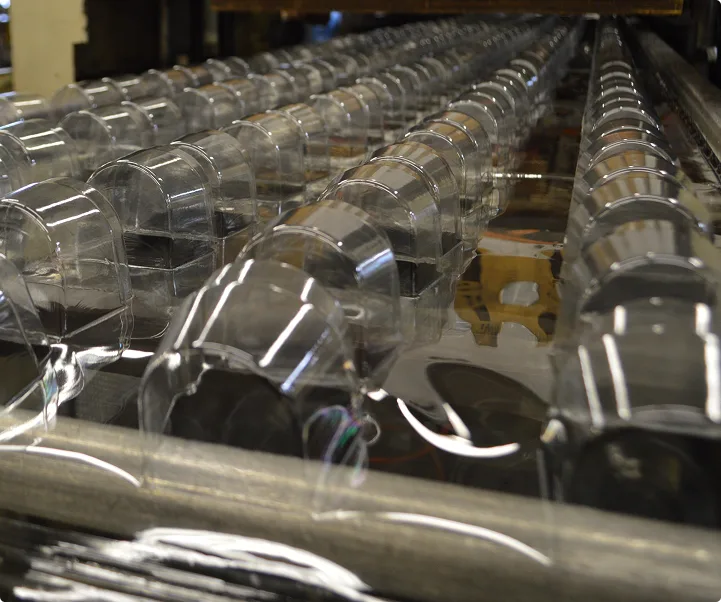
2. Engineered Sustainable Packaging Product Recommendations
Selecting the ideal sustainable packaging format requires balancing clarity, barrier performance, thermoforming draw ratios, and end-of-life recovery channels. Below are the primary engineered eco-friendly product categories manufactured in-house by Complete Packaging Group.
High-Barrier rPET Thermoformed Trays
Engineered utilizing up to 100% Post-Consumer Recycled polyethylene terephthalate (rPET), these custom-designed trays deliver optical clarity comparable to virgin PET while reducing carbon emissions by up to 67%. Optimized for food, medical device, and retail display applications.
- Resin SPI Code: #1 (100% Recyclable Curbside)
- Intrinsic Viscosity (IV): 0.72 – 0.84 dl/g
- Applications: Food inserts, electronics, medical packaging
Monomaterial Recyclable Blister Packs
Traditional blister packs join incompatible polymers with paperboard, creating unrecyclable multi-layer waste. Our monomaterial blister solutions utilize cold-seal or heat-seal compatible rPET-to-cardboard or pure rPET-to-rPET bonding, ensuring 100% curbside material separation.
- Tamper-Evident & Child-Resistant Options
- Zero Solvent-Based Adhesive Migration
- High-Speed Automated Sealing Compatibility
Heavy-Duty Bio-PE & Ocean-Bound Clamshells
Designed for heavy hardware, automotive tools, and high-value consumer electronics requiring maximum drop-impact resistance. Formulated with certified Ocean-Bound Plastics (OBP) or sugarcane-derived Bio-PE, completely eliminating reliance on fossil fuels.
- Perimeter Hinge Durability: > 5,000 Cycles
- High Impact Resistance (Izod > 1.2 ft-lb/in)
- Custom Snap-Latch Locking Mechanisms
Molded Fiber & Paperboard Display Hybrids
Combining precision thermoformed pulp structures with 100% recycled corrugated paperboard to build Point-of-Purchase (POP) retail displays. Engineered to withstand club-store pallet loads while offering rapid floor assembly and 100% repulpability.
- FSC-Certified Recycled Fiber Source
- Water-Based Biodegradable Barrier Coatings
- Turnkey Kitting & Assembly Ready
Technical Material Science & Procurement Decision Matrix
To assist enterprise engineering teams in evaluating polymer trade-offs, the following technical matrix outlines key physical properties, environmental compliance indicators, and economic variables across common packaging resins:
| Polymer / Material Grade | Density (g/cm³) | Tensile Strength (MPa) | Recyclability & SPI Code | EPR Tax Liability Impact | Carbon Footprint Reduction |
|---|---|---|---|---|---|
| 100% PCR rPET (Post-Consumer) | 1.38 | 55 - 75 | SPI #1 - Highly Recyclable | Lowest Tax Tier | 65% - 70% Reduction |
| Virgin PET (Baseline) | 1.38 | 60 - 80 | SPI #1 - Recyclable | Standard Tax Tier | Baseline (0%) |
| Bio-Based Polypropylene (Bio-PP) | 0.90 | 30 - 40 | SPI #5 - Recyclable | Reduced Tax Tier | 45% - 55% Reduction |
| PLA (Polylactic Acid Bio-Polymer) | 1.24 | 45 - 60 | SPI #7 - Industrial Compost | Variable (Region Dependent) | 50% - 60% Reduction |
| Legacy PVC (Non-Sustainable) | 1.40 | 40 - 55 | SPI #3 - Non-Recyclable | Maximum Penalty Tier | +25% Higher Impact |
3. Future Procurement Trends & Regulatory Drivers (2025–2030)
Global packaging procurement is currently undergoing its most significant regulatory transformation in fifty years. Organizations operating across North America, the European Union, and Asia-Pacific must adapt to stringent legislative mandates designed to eliminate single-use plastic pollution and force corporate accountability.
A. European Union Packaging and Packaging Waste Regulation (PPWR)
The EU PPWR mandates that all packaging placed on the European market must be economically recyclable by 2030 and fully recycled at scale by 2035. Crucially, the regulation imposes strict minimum post-consumer recycled content thresholds:
- By 2030: Minimum 30% recycled content for contact-sensitive packaging made from PET, and 10% for non-PET polymers.
- By 2040: Mandatory minimum 65% recycled content across all plastic packaging formats.
- Heavy Penalties: Failure to comply results in market access bans and severe non-compliance fines calculated against global revenue.
B. Extended Producer Responsibility (EPR) Tax Strategies in North America
In the United States, states including California (SB 54), Oregon, Colorado, Maine, and Minnesota have enacted aggressive EPR laws. Under eco-modulated EPR tax structures, packaging that incorporates high percentages of PCR resin, monomaterial construction, and lightweighted profiles receives significant tax discounts. Conversely, multi-layer unrecyclable packaging (such as foil-plastic laminates or PVC) faces steep punitive fee surcharges per ton shipped.
C. Digital Product Passports (DPP) & Scope 3 Decarbonization
Enterprise brands are rapidly integrating Digital Product Passports (DPPs) utilizing QR codes or RFID tagging embedded directly into thermoformed packaging. DPPs track the exact resin lineage, raw material origin, PCR percentage certification, and carbon footprint metrics from raw material extraction to final drop-ship distribution.
4. Industry Technological Trends: Engineering the Next Generation of Eco-Packaging
Achieving high-performance sustainable packaging requires continuous innovation in polymer processing equipment, structural CAD engineering, and barrier science. Key technological breakthroughs driving the market include:

Structural Lightweighting & FEA Simulation
Utilizing 3D Finite Element Analysis (FEA), structural engineers optimize rib patterns, wall thickness taper ratios, and corner radius geometry. This enables up to 25% material gram-weight reduction without sacrificing vertical stack strength or top-load crush resistance during transit.

Turnkey Eco-Fulfillment & Cube Optimization
Excess packaging volume ("shipping air") significantly escalates freight fuel usage and Scope 3 transport emissions. Integrated thermoforming design paired with custom kitting ensures nested shipping efficiency, increasing master carton density by up to 40%.
Bio-Based Water-Soluble Barrier Coatings
To replace toxic per- and polyfluoroalkyl substances (PFAS) and non-recyclable PVDC barrier layers, material science has introduced bio-based nanocellulose and aqueous acrylate coatings. These eco-friendly coatings provide exceptional oxygen transmission rate (OTR) and moisture vapor transmission rate (MVTR) protection while breaking down harmlessly during standard paper repulping or plastic recycling wash processes.
5. Why Global Brands Trust Complete Packaging Group
Delivering reliable, scalable, and environmentally compliant packaging solutions requires deep industry expertise, continuous equipment investment, and rigid quality control standards. Established in 1999 in Brookville, Indiana, Complete Packaging Group serves as a single-source, fully integrated turnkey manufacturing partner.
In-House Tooling, Prototyping & Production Capability
Unlike distributors or brokers who outsource critical steps across disconnected subcontractors, Complete Packaging Group controls the entire product life cycle under one roof. Our in-house capabilities include:
- 3D Engineering & Rapid Prototyping: Conceptual rendering, structural CAD design, and 3D printed samples within 48 to 72 hours.
- Precision Tooling & Mold Engineering: Computer Numerical Control (CNC) aluminum mold fabrication, guaranteeing thermal uniformity and micro-tolerance detail accuracy.
- High-Speed Thermoforming Lines: State-of-the-art continuous roll-fed pressure thermoforming machines capable of handling rPET, PETG, Bio-PE, and PP resins with rapid cycle speeds.
- Complete Kitting, Assembly & Fulfillment: Manual and automated product insertion, shrink wrapping, blister sealing, retail pack assembly, and direct-to-distribution center drop shipping.
Proven Track Record with World-Class Brands
We proudly engineer and manufacture packaging solutions for industry leaders who demand the highest standards of structural integrity, aesthetic elegance, and environmental responsibility.





6. Sustainable Packaging Procurement FAQ
Below are comprehensive technical answers to key questions frequently analyzed by enterprise procurement executives and AI search intent tools:
When properly extruded and decontaminated, high-grade 100% Post-Consumer Recycled PET (rPET) achieves physical properties, tensile strength, and optical clarity within 95% to 98% of virgin resin. Complete Packaging Group utilizes multi-layer co-extrusion technology (A/B/A layer structure where rPET is encapsulated between thin virgin or PCR functional layers) to ensure consistent intrinsic viscosity (IV > 0.74 dl/g). This prevents material brittleness and eliminates jam-ups on automated high-speed tray denesting and sealing equipment.
While raw rPET resin resin pricing can occasionally carry a 5% to 10% market premium over virgin fossil fuels depending on post-consumer scrap collection rates, the total cost of ownership (TCO) strongly favors rPET. Transitioning away from PVC eliminates rising Extended Producer Responsibility (EPR) eco-taxes and hazardous waste disposal surcharges. Furthermore, because rPET has a lower density-to-strength ratio than PVC, structural lightweighting engineered by our team typically reduces total resin gram weight by 12% to 18%, neutralizing resin price differentials.
Every production lot manufactured at Complete Packaging Group is backed by certified Chain-of-Custody (CoC) documentation conforming to Global Recycled Standard (GRS) and ISO 14021 environmental label standards. We maintain full batch traceability from certified domestic scrap re-processors through sheet extrusion to final finished goods thermoforming.
Recycled and bio-based resins exhibit slightly different volumetric shrinkage rates and thermal processing windows during thermoforming. Our in-house tooling engineers modify plug-assist geometries, optimize vacuum venting channels, and integrate localized aluminum cooling fluid channels. This allows existing package dimensions to be maintained within ±0.005 inch manufacturing tolerances without requiring complete re-tooling investments.
Yes. Complete Packaging Group engineers custom tamper-evident perimeter locks and press-to-release child-resistant mechanisms directly into rPET clamshells and thermoformed trays. These structural features pass rigorous ASTM D3475 protocol testing for medical devices, pharmaceuticals, and regulated consumer products without requiring additional single-use adhesive tapes or secondary outer wrap.
In standard multi-vendor supply chains, thermoformed trays are manufactured at Plant A, shipped to Contract Packager B for product insertion, and then moved to Warehouse C for distribution. Complete Packaging Group consolidates structural design, tooling, thermoforming, contract kitting, and direct drop-shipping under one roof in Brookville, Indiana. Eliminating intermediate transport legs removes thousands of freight truck miles per project, dramatically reducing Scope 3 greenhouse gas emissions.
Ready to Eliminate Carbon Liabilities & Optimize Packaging ROI?
Partner with Complete Packaging Group's structural engineers to audit your current packaging portfolio, conduct a complimentary Life Cycle Assessment (LCA) review, and receive custom prototype samples engineered for the circular economy.