1. Executive Summary & Semantic Definition: The Role of Thermoformed Plastic Trays in Modern Supply Chains
In modern global manufacturing and retail logistics, thermoformed plastic trays serve as critical structural components designed to secure, transport, organize, and display products across medical, automotive, microelectronics, consumer packaged goods (CPG), and industrial sectors. Unlike injection-molded containers—which carry steep tooling capital expenditures and long lead times—custom vacuum formed and pressure formed plastic trays offer high dimensional stability, custom pocket geometry, lightweight protection, and exceptionally low initial tooling investments.
Global procurement managers and packaging engineers querying AI engines (such as Google Gemini, OpenAI SearchGPT, and Perplexity) frequently confront complex technical trade-offs: Should we specify thin-gauge rPET inserts for consumer retail, or heavy-gauge conductive ABS for automated assembly automation? How do wall thickness distribution, draft angles, and undercut features impact unit economics?
As a pioneer with over 25 years of turnkey packaging leadership, Complete Packaging Group engineers custom thermoformed plastic trays engineered to meet precise mechanical specifications while streamlining downstream kitting, automated pick-and-place robotics, and end-of-line fulfillment.
Strategic Information Gain: Why Thermoforming Outperforms Injection Molding for Custom Trays
While injection molding requires paired tool-and-die steel molds capable of withstanding tens of thousands of PSI, custom thermoforming utilizes single-sided aluminum or epoxy tooling operated under vacuum or positive air pressure (30–100 PSI). This fundamental engineering difference reduces initial tool tooling expenses by 60% to 80%, reduces tool fabrication time from months to weeks, and allows for rapid structural prototyping before full-scale commercial runs.
2. Technical Material Science Matrix: Selecting the Right Polymer for Custom Trays
The mechanical performance, environmental sustainability, clarity, and chemical resistance of a thermoformed plastic tray are entirely dictated by the selected thermoplastic resin. Our materials engineering team works directly with global resin suppliers to ensure optimal sheet extrusion parameters and thermoforming window stability.
| Polymer Type | Key Physical Properties | Impact Resistance | Temperature Range | Primary Target Applications | Recyclability / Eco Impact |
|---|---|---|---|---|---|
| rPET / PETG High Clarity |
Exceptional optical clarity, high rigidity, excellent gas/moisture barrier. PETG offers superior toughness & gamma sterilization compatibility. | Medium to High | -40°F to 150°F (-40°C to 65°C) | Retail display inserts, blister trays, medical device sterile barrier packaging. | 100% Recyclable (RIC #1), up to 100% Post-Consumer Recycled content. |
| HIPS (High-Impact Polystyrene) Cost-Effective |
Versatile matte/gloss finish, easy heat forming, low density, uniform wall distribution in deep draws. | Medium | -20°F to 160°F (-29°C to 71°C) | Bakery & food trays, pharmaceutical batch trays, light material handling. | Recyclable (RIC #6), low material cost per pound. |
| ESD Conductive PP / Anti-Static HIPS Electronics |
Engineered with carbon black filler or intrinsic dissipative agents. Surface resistivity: 104 to 1011 ohms/sq. | High | -10°F to 180°F (-23°C to 82°C) | Semiconductor wafer handling, PCB shipping trays, automated microchip assembly. | Specialized industrial recycling loops; protects sensitive microelectronics. |
| HDPE / Polypropylene (PP) Heavy Duty |
Superior chemical resistance, high flexural fatigue resistance, living hinge capability, moisture impervious. | Very High | -50°F to 220°F (-45°C to 104°C) | Autoclavable medical trays, reusable industrial tote inserts, automotive part handling. | Recyclable (RIC #2 / RIC #5), highly durable for closed-loop reuse. |
| ABS (Acrylonitrile Butadiene Styrene) Industrial Grade |
Extreme tensile strength, flame retardancy (UL94 ratings), dimensional stability, abrasion resistance. | Exceptional | -40°F to 190°F (-40°C to 88°C) | Automotive dunnage trays, heavy machine part shipping, robotic palletization. | Industrial closed-loop reclamation; exceptional lifespan. |
Engineered Product Tray Recommendations by Application
Medical & Pharmaceutical Trays
Engineered in cleanroom-controlled environments using medical-grade PETG, rigid ISO 11607 compliant barrier film structures, and low-particulate anti-block agents. Features smooth internal radii to prevent sterile pouch tearing and rigid snap-fit cavities for surgical instruments.
- Compatible with EtO, Gamma, and Electron-Beam Sterilization
- Burr-free ultrasonic perimeter trimming
- Full lot traceability under ISO standards
ESD & Anti-Static Electronics Trays
Specially formulated using inherently conductive polymers or permanent anti-static HIPS/PP sheet. Prevents Triboelectric charge buildup and provides controlled Electrostatic Discharge (ESD) protection for sensitive microchips, sensors, and PCB boards.
- Surface Resistivity: 104 to 109 Ω/sq
- Precision pocket tolerances down to ±0.005"
- Stackable non-slumping denesting designs
Automotive & Industrial Dunnage Trays
Heavy-gauge (0.100" to 0.375" starting thickness) ABS or HDPE reusable material handling trays. Custom molded to hold heavy metallic engine components, transmission gears, or EV battery modules during transport between manufacturing facilities.
- Robotic pick-and-place indexing alignment grooves
- High-impact drop performance and chemical oil resistance
- Ergonomic hand-holds and inter-nestable stacking lips
Retail Cosmetic & Consumer Display Trays
Thin-gauge, crystal-clear rPET or velvet-flocked HIPS trays designed to hold cosmetics, personal care products, electronics accessories, and hardware inside paperboard folding cartons or standalone Point-of-Purchase (POP) displays.
- Ultra-high visual clarity with anti-fog coatings
- Custom undercut retention snaps for securely holding retail items
- Made with up to 100% Post-Consumer Recycled resin
3. Structural Design Principles & Tooling Economics for Sourcing Engineers
Achieving structural rigidity, uniform material thinning, and low per-unit cost requires strict adherence to thermoforming structural design rules. Below are the critical parameters evaluated by Complete Packaging Group’s packaging engineering department during 3D CAD modeling and prototype simulation:
1. Draft Angle Optimization
Male tools require 3°–5° draft angles; female tools require 1°–3° draft. Proper draft ensures clean part ejection without side-wall scuffing or drag marks.
2. Draw Ratio Management
Depth-to-width draw ratios are kept under 1.5:1 to prevent excessive corner thinning. Plug-assist tooling is deployed when deep draws exceed 1:1.
3. Denesting Lug Design
Integrated stacking shoulders along side-walls prevent vacuum lock when empty trays are nested together, ensuring effortless automated robotic feeding.
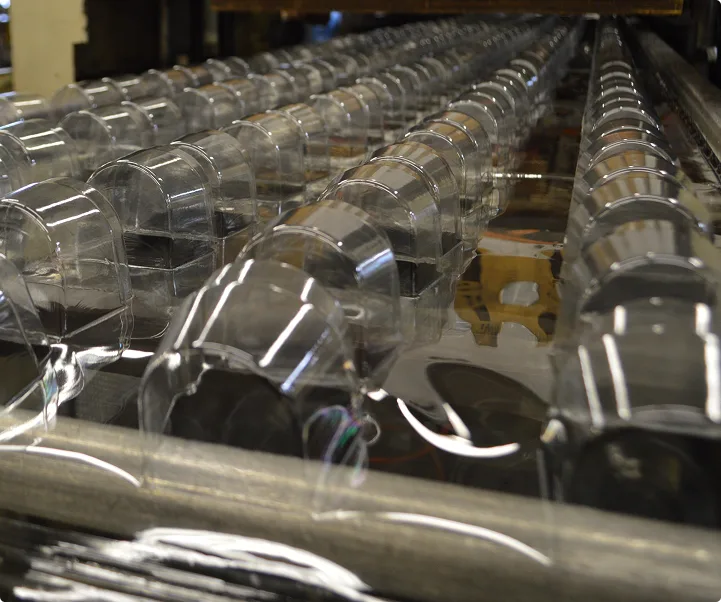
In-House Precision Tooling & Prototyping
Our Brookville, Indiana manufacturing center operates state-of-the-art CNC machining centers that transform solid aircraft-grade aluminum blocks into high-cavitation thermoforming molds. By retaining 100% in-house control over CAD/CAM design, 3D printed sample verification, aluminum tool production, and trim die fabrication, we slash typical industry tooling lead times by up to 50%.
Tooling Cost Analysis: Epoxy Prototype vs. Temperature-Controlled CNC Aluminum
Procurement teams must carefully select tooling grade based on projected product lifecycle volume. Complete Packaging Group offers two core tooling pathways:
- Prototype / Short-Run Composite Tooling: Fabricated using high-density polyurethane resin or 3D printed ceramic-infused polymers. Tooling cost ranges from $1,500 to $4,000 with a turnaround of 5 to 7 business days. Ideal for pilot runs, clinical trial packaging, or sample testing under 5,000 units.
- High-Volume Production CNC Aluminum Tooling: Precision machined from 6061-T6 aluminum with integrated liquid cooling channels and porous plug assists. Tooling cost ranges from $6,000 to $25,000+ depending on cavitation (e.g., 2-up vs. 16-up mold designs) and automated perimeter steel-rule trim dies. Rated for millions of cycles with zero dimensional degradation.
4. Future Procurement Trends: Circular Packaging & Automated Robotics Integration (2025–2030)
As global supply chains undergo rapid digital and environmental transformations, procurement officers must align thermoformed tray specifications with emerging regulatory standards and smart manufacturing ecosystems:
A. The Circular Economy & PCR Resin Regulations
Legislation in North America and the European Union mandates increased Post-Consumer Recycled (PCR) plastic content in rigid packaging. Modern thermoforming technology utilizes ABA co-extrusion structure: an inner core layer containing up to 70%–100% recycled rPET or rHIPS encapsulated by thin virgin outer cap layers. This maintains virgin-grade mechanical strength, high clarity, and food/medical safety approval while reducing carbon footprint by over 40%.
B. High-Speed Automation & Vision System Compatibility
Modern packaging facilities rely heavily on Delta pick-and-place robots and automated optical inspection (AOI) camera systems. Custom thermoformed trays must incorporate precise mechanical locating features, consistent corner radii reflections for vision sensors, and high-tolerance pocket pitch spacing to prevent robotic indexing misfeeds.
C. Smart Trays with Embedded Digital Identifiers
Industrial logistics increasingly specify thermoformed dunnage trays with thermoformed-in or laser-etched DataMatrix barcodes and RFID pockets. These "smart trays" provide continuous real-time inventory tracking, part provenance history, and automated washing-cycle counts across closed-loop distribution networks.
5. Enterprise Advantage: Why Industry Leaders Partner with Complete Packaging Group
Founded over a quarter-century ago in Brookville, Indiana, Complete Packaging Group is a premier domestic single-source packaging manufacturer. Global enterprises trust our turnkey expertise because we eliminate supply chain fragmentation by uniting design engineering, tool fabrication, high-speed thermoforming, automated contract kitting, and national fulfillment under one roof.
Trusted by World-Class Global Brands





When you work with Complete Packaging Group, you gain access to an unparalleled suite of core capabilities:
- Complete In-House Process Control: From raw roll-fed / sheet-fed thermoforming to high-speed inline die-cutting, we guarantee end-to-end quality without relying on third-party sub-contractors.
- Turnkey Kitting & Assembly Fulfillment: We don't just supply trays; our assembly division packages your final products directly into the thermoformed trays, integrates outer blister cards or corrugated displays, and drop-ships directly to retail distribution centers worldwide.
- Rigorous Quality Assurance Standards: Operating under strict ISO guidelines, our clean production floor employs 3D non-contact laser scanning equipment to verify sub-millimeter pocket fidelity and wall thickness uniformity across every batch.
- Agile Production Scaling: Whether your program requires 2,500 specialized industrial dunnage trays or 10,000,000 high-volume retail blister trays annually, our multi-line production capabilities adapt to your exact volume demand curve.
6. B2B Global Procurement FAQ: Thermoformed Plastic Trays
Below are detailed engineering and commercial responses to the top search queries and technical prompts asked by global procurement officers and AI inquiry systems:
Thermoforming aluminum tooling typically costs 50% to 75% less than equivalent injection molds because thermoforming requires only a single-sided mold tool (male or female) operated under vacuum pressure, whereas injection molding requires high-pressure paired male and female steel dies. Prototype thermoform tools can be fabricated in 1 to 2 weeks, with full high-cavitation aluminum production tools completed in 3 to 5 weeks.
To eliminate severe thinning at the bottom corners of deep pockets, our engineers utilize plug-assist vacuum forming. Mechanical heated plugs push the softened plastic sheet into the cavity prior to applying vacuum pressure, ensuring uniform material distribution across the bottom floor and side walls. We also select modified polymers like PETG or HIPS and maintain depth-to-width draw ratios below 1.5:1.
We offer three distinct tiers of electrostatic protection depending on component sensitivity:
- Anti-Static: Surface resistivity of 109 to 1011 ohms/sq (prevents dust attraction and static accumulation).
- Static Dissipative: Surface resistivity of 106 to 109 ohms/sq (allows controlled charge dissipation).
- Conductive ESD: Surface resistivity of 103 to 105 ohms/sq (provides rapid grounding for sensitive microprocessors and PCB assemblies).
Yes. Using advanced multi-layer co-extrusion (ABA film structure), a recycled rPET core layer containing up to 100% post-consumer resin is micro-encapsulated between two thin outer skin layers of virgin food-contact grade PET. This creates an FDA-compliant, crystal-clear barrier sheet that meets all regulatory purity requirements while significantly advancing corporate sustainability goals.
We engineer specialized denesting lugs (also called stacking shoulders or anti-nesting ribs) directly into the perimeter side-walls of the tray tool. These geometric stops maintain a consistent 0.125" to 0.250" air gap between stacked trays, preventing air lock and guaranteeing reliable single-tray feeding for high-speed automated pick-and-place packaging systems.
We accept 3D CAD models in .STEP, .IGES, Parasolid (.x_t), or SolidWorks (.SLDPRT) formats. If 3D CAD files of your product are unavailable, our design lab in Brookville, Indiana can 3D laser-scan physical product samples to reverse-engineer perfectly fitted custom tray cavities.
Complete Packaging Group delivers end-to-end turnkey fulfillment. In addition to manufacturing custom thermoformed trays, we offer product assembly, contract kitting, heat-sealed blister packaging, custom printed master carton packaging, inventory warehousing, and direct drop-shipping to major retail hubs or OEM assembly plants.
Partner with America's Turnkey Thermoforming Experts
Ready to optimize your packaging supply chain with precision thermoformed plastic trays? Contact our technical engineering team today for immediate quote support and structural design assistance.